English Is the New Source Code
Imagine handing a builder a napkin sketch and saying, "Make me a house." You might get a house. You would not get your house. Now imagine handing over a clear set of plans, with every room, rule and limit written down. The builder, however skilled, now has a fair chance of building what you meant.
Software has reached that moment. The best results from AI coding agents no longer come from clever prompts. They come from a written specification that says what to build and why, and the code follows from it. This approach is called spec-driven development, and it is quickly becoming the standard way to work.
What spec-driven development is
Spec-driven development means writing down what you want before any code exists, and treating that document as the source of truth. The code is a result of the document, not the other way around.
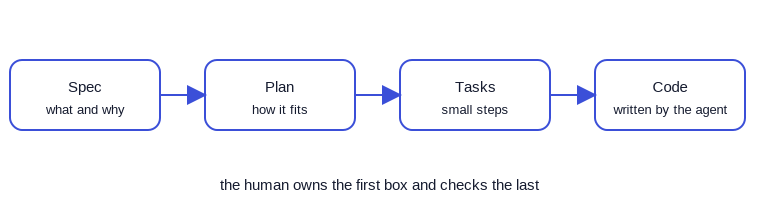
The usual flow has four steps. First you write the spec, which describes what the thing should do and why. Next the agent turns it into a plan for how the pieces fit. The plan is split into small tasks. Then the agent works through the tasks and writes the code.
Open-source toolkits now exist to guide this flow with templates and ready-made commands for the main coding agents. The idea in their own words is simple: define what and why before deciding how.
Why it replaced vibe coding
Early AI coding was a chat. You described a feature, the model wrote some code, you described the next feature. This is often called vibe coding, and it works well for small experiments.
It falls apart as a project grows. The model forgets earlier decisions, repeats work, and slowly drifts away from what you wanted. Each new chat starts with a blank memory, so the project's rules live only in your head.
A written spec fixes this. It is a memory that never gets tired and never gets lost between sessions. Any new agent can read it and know the goals, the limits and the style. The agent is no longer guessing. It is following instructions.
Why English works as code
For most of computing history, the precise language was the program and English was a loose commentary around it. That is now flipped. English is the precise layer that humans write, and the code is the detailed result an agent fills in.
This works because modern models read English well. They can follow long, carefully written documents and turn them into working programs. A sentence like "players start at the center of the world and cannot be attacked on the road" is now close to an executable instruction.
It also changes who can build. A person who writes clearly and thinks carefully about what they want can now ship software without typing a line of code. That is the heart of being a maker instead of a developer: the skill is deciding what to build and checking that it is right.
Put the human detail at the top
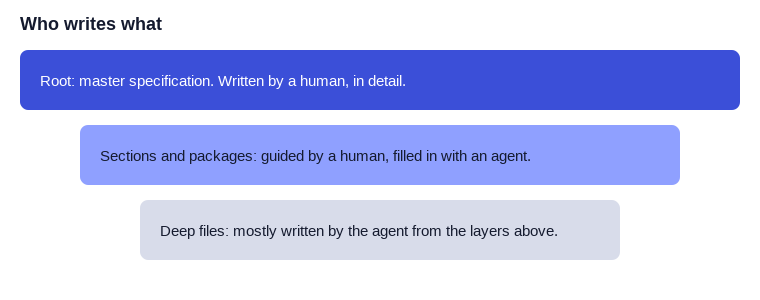
Here is the most useful rule we have found. The highest level of a project should be the most carefully written by a human, and the deeper you go, the less a human needs to write.
At the root sits a master specification. It holds the vision, the rules that must never be broken, the structure of the project and the definition of done. A person writes and guards this file with great care. Everything below is measured against it.
Under the root are sections and packages. A human still guides them, but at a lighter touch: a short description of what each part is for and how it connects to its neighbors. The agent fills in the detail. In the deepest folders, individual files are mostly produced by the agent from the layers above.
The logic is about leverage. A mistake at the root spreads into everything below it, so it deserves the most human attention. A mistake in a single small file is cheap to find and fix. Spend your effort where errors cost the most.
How the layers load
Coding agents already work this way. Many read a project instruction file at the root of a repository, and then read extra files in the subfolder they are working in. More specific files load later and take priority over general ones.
Root files hold what the whole project needs, such as the architecture, naming rules and how to test. Subfolder files hold the rules for one area, and they load only when the agent works there. This keeps each file short, which matters because every word is loaded into the model's limited memory at the start of a session.
There is one hazard to watch. A stale file deep in the tree that contradicts the root can quietly win inside its folder. When the root changes, the layers beneath must be checked.
Code with no comments
A spec-driven project treats comments in code as a smell. If the code needs a note to explain itself, then either the code is unclear or the explanation belongs in the specification.
This is a clean division of labor. The English documents explain the why. The code shows the what and nothing else. When a person wants to know why something exists, they read the spec. When they want to know what it does, they read the code. Nothing is explained twice, so nothing drifts out of date in two places.
Small, separate modules help too. If every file does one job and has a clear name, an agent can load just the file it needs, change it, and move on. Big tangled files force the agent to hold far more in its head than it should.
A folder scheme that works
A simple layout does a lot of the work. This is the structure our own studio uses.
APP-SPECIFICATION.md
SRC-FORMAT.md
src/
code/
assets/
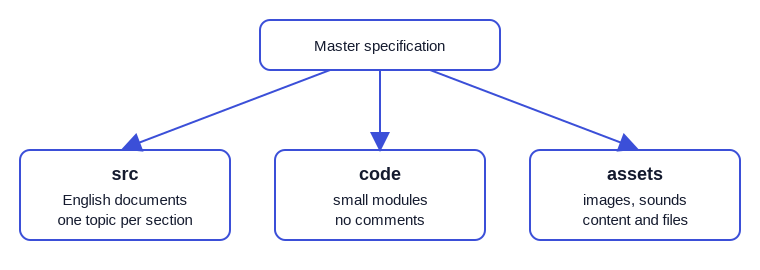
- The master specification sits at the root and describes the whole project.
- A second root file sets the rules for how the English documents are written.
- The src folder holds only English documents, each section covering one topic.
- The code folder holds the program in small modules, with no comments.
- The assets folder holds everything else, such as images, sounds and content.
The point is that anyone, human or agent, can tell where a thing belongs without searching. A fixed scheme also means the agent spends its effort on the task and not on finding its way around.
The master specification is also protected. In our projects the agent is told never to edit it. Only a person changes the plan, so the agent cannot quietly rewrite the goal to fit its own work.
What goes in a master specification
A good master specification is short enough to read in one sitting and firm enough to settle arguments. These parts earn their place.
- Vision: one paragraph on what the project is and who it serves.
- Rules: the things that must always be true, and the things that must never happen.
- Structure: the folders, the main parts and how they connect.
- Style: how the code and the writing should look.
- Done: the checks that tell you the work is finished, ideally ones a program can run.
The last item matters most. A spec that says what success looks like gives the agent a target, and gives you a way to check without reading every line.
Three levels of using a spec
Not everyone uses specs the same way. Writers on the subject describe three levels.
- Spec-first. The spec starts the work, and after the first version the team mostly edits the code.
- Spec-anchored. The spec stays alive, and spec and code are kept in step as the project changes.
- Spec-as-source. Humans edit only the spec, and the code is generated and treated as disposable.
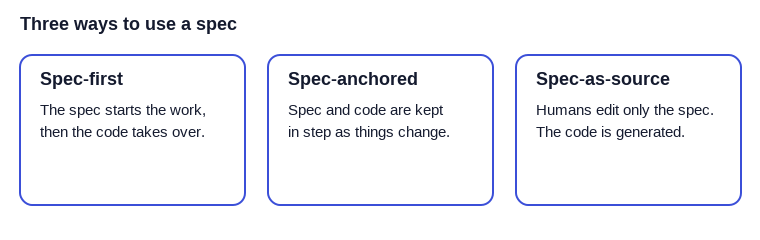
Most teams today sit at the first or second level. The third is the direction of travel, and a few tools already mark generated code as do-not-edit. Our approach is closest to the second level, with a firm push toward the third as agents improve.
Why now
Spec-driven development is an old idea. Writing requirements before code has been advice for decades. What is new is that the idea finally works for large projects.
The reason is how long an agent can work on its own. Researchers measure this as the length of task a model can finish with a reasonable chance of success, judged by how long the same task takes a human expert. Their analysis found this length doubling about every seven months over several years, and more recent data suggests the pace has picked up.
A few years ago a model could manage tasks that took a person a few minutes. Then it could manage hours. Now agents run through long stretches of work with little help, and tasks that once needed a team for weeks are within reach of one person with a clear plan.
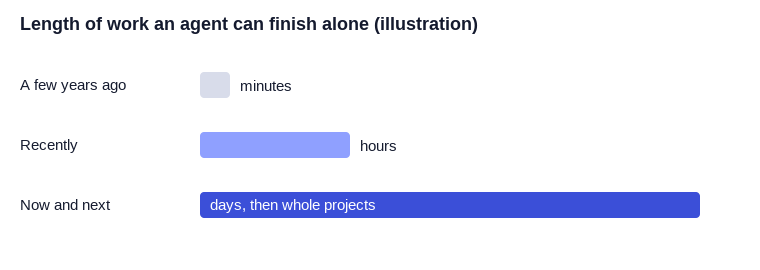
This chart is an illustration of the trend, not a precise measurement.
Whole games, books and programs
This shift is why complete products are suddenly possible. A video game is thousands of small decisions that must fit together. A book is a long chain of ideas that must stay consistent from the first chapter to the last. A program is many parts that must agree.
Before, an agent lost the thread long before the end. With a master specification, the thread is written down. The agent can return to it at any point, check what it has built against what was promised, and carry on. The spec is the long memory that the model alone does not have.
The result is that one person with a clear specification can now produce things that once needed a studio, a publisher or a team. The limit has moved from typing speed to clarity of thought.
The honest cautions
Spec-driven development is not magic, and thoughtful engineers have raised fair concerns.
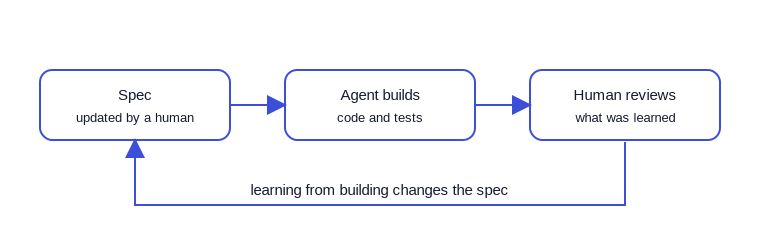
- A spec written once and never changed repeats the old failures of heavy up-front planning. Building teaches you things, and the spec must learn with it.
- Reading long documents can be as tiring as reading code, so specs should be short and clear.
- Agents do not always follow instructions, even good ones, so results must be tested.
- The same spec can produce different code each time, so tests matter more than ever.
- The phrase itself is used loosely, and teams mean different things by it.
The answer to all of these is feedback. Treat the spec as a living document. Build a little, learn, update the spec, and let the code follow.
How to start
You do not need special tools to begin. You need a text file and some patience.
- Write a master specification. Say what you are making, who it is for, and what must never happen.
- Add a short section for each major part, with one topic per section.
- Decide on a folder scheme, and tell the agent to follow it.
- Ban comments in code, and put the explanations in the English documents.
- Forbid the agent from editing the master specification.
- Ask for a plan and a task list, review them, then let the agent build.
- Test the result, and update the spec with what you learned.
The skill that matters now is not typing code. It is writing clearly about what you want, and noticing when the result is not it. English has become the source code, and the best programmers of the next decade may be the best writers.
Sources
- github.com/github/spec-kit
- agentpatterns.ai/instructions/hierarchical-claude-md
- metr.org/blog/2025-03-19-measuring-ai-ability-to-complete-long-tasks
- thoughtworks.com/insights/podcasts/technology-podcasts/what-is-spec-driven-development
- devtoollab.com/blog/spec-driven-development-ai-agents