Become the Greatest Clean Code English Writer
Here is a strange fact about modern software. Two developers can sit in front of the same AI, type for the same ten minutes, and walk away with very different programs. One gets a tidy, correct feature that fits the codebase. The other gets four hundred lines of code nobody asked for.
The difference is not luck, and it is not a secret prompt. It is knowing what the AI actually is, and how to reach into it for exactly the piece you need. That skill is quickly becoming the center of software engineering.
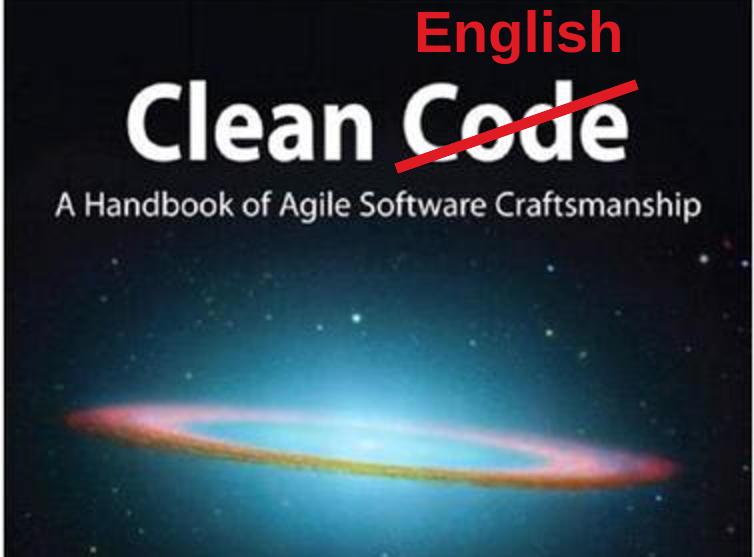
This post explains the idea from the ground up. By the end you will know why a language model behaves like a library of human knowledge, why fewer and better words beat more words, and what you must still learn yourself to do it well. The goal is simple: to become the greatest human clean code(woops) English writer.
What a language model really is
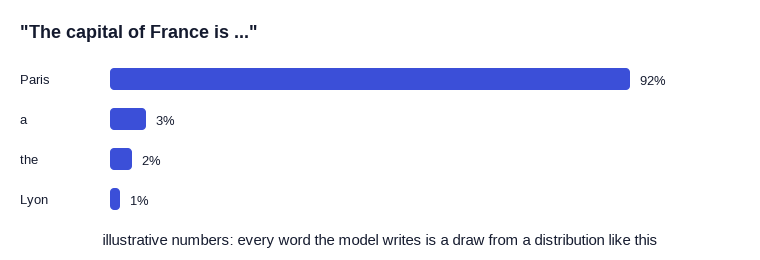
A large language model does one thing. Given some text, it predicts the next small piece of text, called a token. It does this by assigning a probability to every token it knows, then picking one. Then it adds that token to the text and does it again.
That sounds too simple to write programs, but think about what it takes to predict well. To guess the next word in a sentence about tax law, the model must have absorbed something about tax law. To guess the next line in a function that parses dates, it must have absorbed how dates and parsers work. Predicting well forces the model to learn the patterns underneath the text.
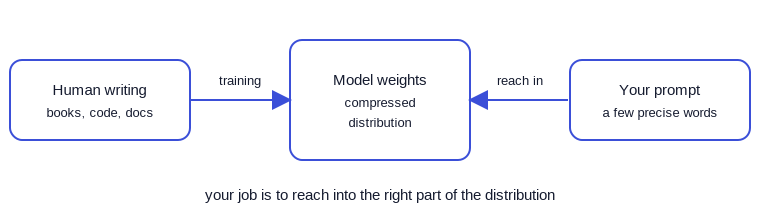
Researchers describe this as compression. Training on enormous amounts of human writing squeezes what is in the text into the model's weights, the billions of numbers that make up the model. Recent work describes language models as compressing knowledge through next-token distributions, and calls what is stored in the weights parametric knowledge. It is flexible and fast to use, but also lossy, frozen at training time, and hard to audit.
A distribution of human knowledge
Here is the plain version. Millions of people wrote down how to do things: how to sort a list, how to handle a refund, how to set up a build, how to explain a diagnosis. The model read a huge share of that writing and kept a statistical summary of it. Ask it a question, and you are not looking up one stored answer. You are drawing from a distribution shaped by everything humans wrote about that topic.
This explains both the magic and the mistakes. Where many people wrote the same good thing, the distribution is sharp, and the model is reliably right. Where the topic is rare, new or disputed, the distribution is flat or wrong, and the model guesses with the same confident voice. It also explains why the model usually gives you the common answer, the one most people wrote, even when a rarer answer would suit you better.
A setting called temperature controls how the draw is made. Low temperature makes the model favor the most likely token. High temperature gives unlikely tokens a better chance. The math is a small change to a function called softmax, and the effect is the difference between a careful clerk and a loose brainstormer. Most coding tools keep it fairly low, because code rewards the likely answer.
Your prompt is a reach into the distribution
If the model is a compressed library of human knowledge, then a prompt is not a command. It is a way of conditioning the distribution. Every word you write changes which parts of the library are likely to come out. Research on next-token models describes this directly: the context you provide shifts the probabilities of everything that follows.
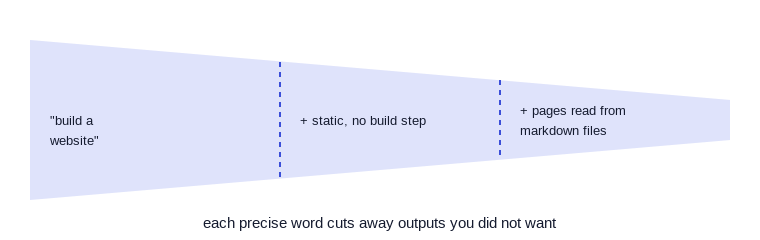
Consider two requests. "Make a website" could lead anywhere. A site for a bakery, a framework with forty dependencies, a single HTML file. "Make a static site with no build step, where each page is read from a markdown file" points at a much smaller region of what humans have written. The model has seen that pattern many times. The second request is not just longer. It is more precise, and precision is what narrows the distribution.
This is the part that matters most. Good prompting is not about magic phrases or politeness or length. It is about choosing the few words that select the right region of human knowledge. The model already holds the answer's ingredients. Your job is to point.
From passing the compiler to pulling knowledge
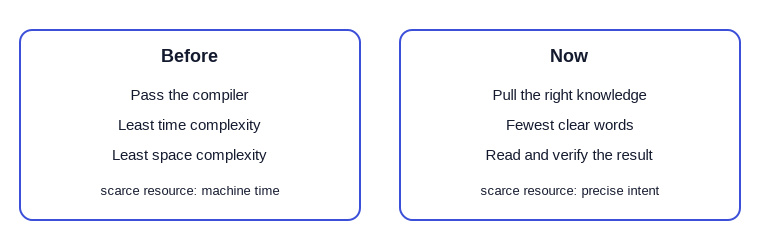
For most of the history of programming, the scarce resource was the machine. Memory was small and processors were slow. A developer's craft was to write code the compiler would accept and that used the least time and the least space. Big-O notation, careful data structures and clever loops all came from that world.
Those things still matter, and we will come back to why. But the daily work has changed. When an agent can write a hundred lines in seconds, the machine is no longer what limits you. What limits you is how clearly you can say what you want. The new craft is pulling the right knowledge and the right code out of the model, with as few words as possible, in words a human can read, while the AI does as much of the work as it can, exactly as you wanted.
Andrej Karpathy captured this when he said that the hottest new programming language is English, and described a "Software 3.0" in which the program is a prompt written in natural language. The compiler used to be your first reader. Now the model is, and the question has moved from "will it compile?" to "will it understand me?"
Why fewer words is the goal
You might wonder why we want few words. Why not write a long, detailed prompt and cover every case? There are three good reasons.
First, every word is loaded into the model's limited memory, called its context window. Long instructions crowd out the code and documents the model needs to see. Second, long instructions are harder for you to read and keep correct. A thousand-line prompt is a program with no tests. Third, extra words can pull the distribution in directions you did not intend. Each sentence is a push, and a pile of pushes goes somewhere unexpected.
The aim is not the shortest text. It is the smallest text that fully selects what you want. A good prompt is like a good function: it does one thing, every part earns its place, and a stranger can read it. Short and precise beats long and vague, but short and vague is just a wish.
The ponytail idea
A small project shows this idea in action. Ponytail is an agent skill created by Dietrich Gebert, and it spread quickly, gaining more than twenty thousand stars in about a week. It is a short markdown file that tells a coding agent to "think like the laziest senior dev in the room." Its motto is that the best code is the code you never wrote.
The problem it fixes is familiar. Left alone, models over-engineer. They add classes, options and helpers that nobody asked for, because the distribution of public code is full of exactly that kind of code. Ponytail pushes the model toward the rarer, better habit of senior developers: do less, reuse more.
It does this with a short ladder the agent must climb before writing anything new. At each rung, the agent stops if the answer is yes.
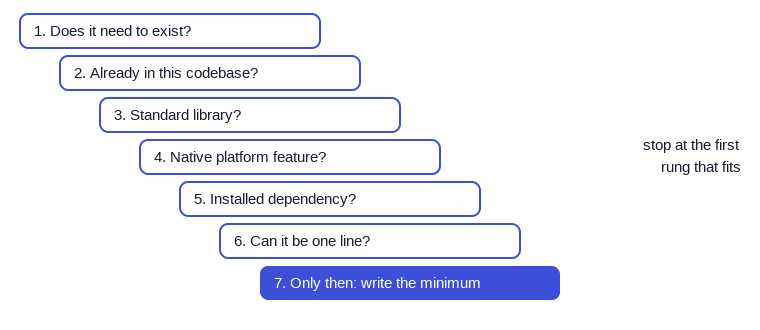
- Does this need to exist at all?
- Is it already in this codebase?
- Does the standard library do it?
- Is there a native platform feature?
- Can an installed dependency handle it?
- Can it be one line?
- Only then, write the minimum that works.
The author reports about 53 percent fewer lines of code against a baseline with no skill, along with fewer output tokens and lower cost. The skill is also careful about one thing: it is lazy about writing code, never about understanding the problem. The agent reads the real flow of the codebase first.
What ponytail teaches, and what it admits
Ponytail is a lesson in reaching into a distribution with very few words. A hundred lines of markdown steer the model away from the crowded middle of "typical code" and toward the thoughtful corner where senior developers live.
An independent look at it is just as instructive. A blog from the consultancy Scott Logic tested whether tiny prompts could match it. With no skill, a task produced about 108 lines of code. Adding the words "Follow YAGNI principles," which refers to the old rule "you ain't gonna need it," cut that to about ten lines. Adding "and one-liner solutions" brought it to about seven, slightly better than Ponytail's own result of about eight, with the same correctness.
That is a wonderful result for our argument. Seven words did most of what a hundred lines did, because those seven words pointed at a region of human knowledge the model already held. Ponytail is not magic. It is a well-chosen pointer. The lesson is not "install this skill." The lesson is that the best programmers will be the ones who know which few words to say. That is what we mean by becoming the greatest human ponytail: someone who gets the most from the model with the least input, and still understands the work.
Specs are how you write English as code
The same skill appears in spec-driven development, which we covered in our post on how English is the new source code. There the idea is that a written specification, not a clever chat message, is the source of truth, and the code follows from it. A spec is just a prompt that is organized, durable and checked.
Notice how much of that practice is about pointing precisely with few words. The master specification holds the vision, the rules that must never be broken and the definition of done. Folders hold short documents, one topic each. Code carries no comments, because the explanations live in the English documents. Each of these habits keeps the instructions small, clear and non-repeating.
Read as a statistical idea, a good spec does two jobs. It conditions the model toward your project's region of the distribution, using your names, your rules and your style. And it gives you something to check the output against. Without the second job, you are only hoping the draw went your way.
Why computer science still matters
This is where many people get the story wrong. If English is the new source code, do you still need computer science? You need it more.
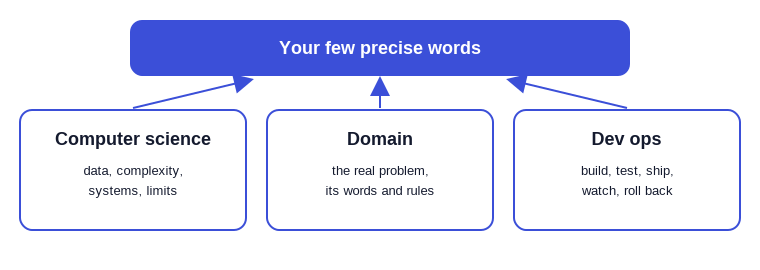
The model draws from what humans wrote, and that includes plenty of bad code. To pick the good draw from the bad one, you must recognize it. A developer who understands data structures can see that the model chose a list where a hash map belongs, and fix the request with one precise sentence. One who understands complexity notices when code that looks fine will crawl on ten million rows. A developer who knows how memory, concurrency and networks behave can ask for the right thing in the first place.
Computer science also gives you the vocabulary. Words like "idempotent," "immutable," "queue," "index" and "cache" are dense pointers into the distribution. Each one selects a large, well-understood body of human knowledge in a single word. A person who does not know the words must use paragraphs to say what the expert says in a phrase. Knowing the field is how you get short prompts that land.
Why domain knowledge matters just as much
The model has read about almost every field, but it has not worked in yours. It does not know that in your clinic a "visit" and an "encounter" are different things, or that your warehouse never ships on Sunday, or that your users are nervous and in a hurry. Those details decide whether software is useful, and they live in people's heads.
Domain knowledge also tells you what to ask for. A developer who has spent years in accounting knows that money should never be stored as a floating point number, that every entry needs a matching entry, and that records must be kept for audits. Say so in one sentence, and the model pulls up the right patterns. Fail to say so, and you get the common answer, which may be quietly wrong.
There is a deeper point as well. The model is best where humans wrote a lot, and weakest where they wrote little. Your specialized work, your company's rules and your newest ideas sit in the thin tails of the distribution. There, your own knowledge is not a nice extra. It is the main input, and you must supply it in your words.
Why dev ops knowledge closes the loop
A draw from a distribution is not a finished product. It is a candidate. To know whether it works, you must build it, test it, ship it and watch it run, and that is the world of dev ops.
Dev ops is how you turn the model's guesses into evidence. Automated tests tell you whether the code does what the spec says. A build pipeline tells you whether it compiles on a clean machine. Logs, metrics and alerts tell you how it behaves with real users. Version control and rollbacks let you undo a bad draw without panic. Because the same prompt can give different code each time, these checks matter more than they ever did.
It also changes what you ask for. A developer who thinks in terms of pipelines will write "add a test that fails first, then make it pass" and "run the type checker before you finish." These few words turn the model from a writer into a worker that checks itself.
The loop that makes you better
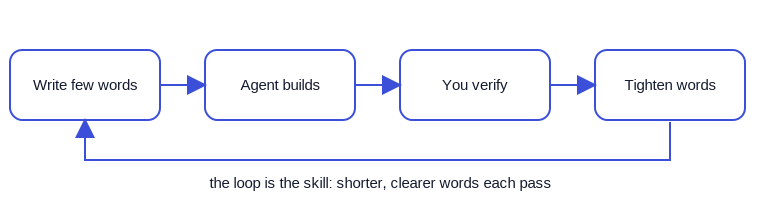
Put it together and a rhythm appears. You write a few precise words. The agent builds. You verify with tests, with reading and with your own knowledge. You see where the result missed, and you tighten the words. Then you go again.
Each pass teaches you something about the distribution: which words select what you meant, which words pull in extras, which gaps the model fills with the common answer. Over time, your prompts get shorter and your results get better. You start to feel the shape of what the model knows, the way a good editor feels the shape of a manuscript.
How to practice
You can start today without any new tool. A few habits will carry you a long way.
- Say the goal and the limit. One sentence for what, and one for what must never happen.
- Use the field's own words. Learn the exact term for what you want, and use it.
- Point at what exists. Name the file, the function or the library you want reused, so the model does not invent a new one.
- Ask for the smallest thing that works, then grow it.
- Ask for a check. Request a test, a command to run or a clear way to see success.
- Read everything the agent writes, at least at first. Your reading is how you learn the distribution.
- When it fails, cut or sharpen words before you add them.
- Write down what worked in your spec, and treat it as code you maintain.
Try an experiment. Take a task you gave an agent last week. Write the prompt again in half the words, using the most exact terms you know, and compare the results. You will learn more from that than from any list of tricks.
The greatest human ponytail
Software engineering has not become easier. It has become different. The old test was whether the compiler would accept your code. The new test is whether you can reach into a vast, compressed record of human knowledge and pull out exactly what you need, in words so clear and so few that the result is right the first time or the second.
That takes the old foundations. Computer science to know what good looks like and to speak in dense, exact terms. Domain knowledge to know what matters and to fill the thin places where the model is weak. Dev ops to prove the result works and to keep it working. It takes the new craft too: writing a spec, tightening your words and checking the output.
A ponytail is a simple thing, a bundle gathered and held with one small band. The best developers will do the same with the model. They will gather the right knowledge, hold it together with a few exact words, and let the machine do the rest. Learn the field, learn the words, and become the greatest human ponytail.
Sources
- Ponytail by Dietrich Gebert: github.com/DietrichGebert/ponytail
- Scott Logic, "ponytail, yagni and the problem with prompt benchmarks": blog.scottlogic.com/2026/06/16/ponytail-yagni-and-the-problem-with-prompt-benchmarks.html
- "From Chatbot to Digital Colleague: The Paradigm Shift Toward Persistent Autonomous AI": arxiv.org/pdf/2606.14502
- "I Predict Therefore I Am: Is Next Token Prediction Enough to Learn Human-Interpretable Concepts from Data?": arxiv.org/abs/2503.08980
- "The Effect of Sampling Temperature on Problem Solving in Large Language Models": arxiv.org/pdf/2402.05201
- Andrej Karpathy, "Software Is Changing (Again)": conffab.com/elsewhere/andrej-karpathy-software-is-changing-again
- Our earlier post, "English Is the New Source Code": 3.md