Danger and combat
Beta. The world is under active development and details may change. Anything marked "in development" is not finished or has not been checked in the game yet.
The further you are from the centre, the stronger everything becomes. Understanding the level indicator is the single most useful thing you can learn.
The level indicator
The level indicator is a number for every spot in the world.
- It is 1 anywhere within 199 tiles of the centre.
- It goes up by 1 for every further 200 tiles. So 201 tiles out is level 2 and 401 tiles out is level 3.
- Distance is measured separately east-west and north-south, and the larger of the two counts. That makes the levels form square rings around the centre, not circles.
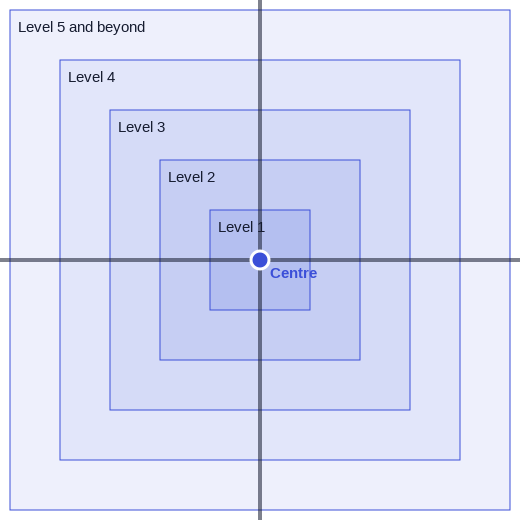
Level rings around the centre. Not to scale beyond level 5.
| Distance from the centre (largest of east-west or north-south) | Level indicator |
|---|---|
| 0 to 199 tiles | 1 |
| 200 to 399 tiles | 2 |
| 400 to 599 tiles | 3 |
| 1,000 tiles | about 6 |
| 3,000 tiles | about 16 |
| The edge of the beta sector, about 7,500 tiles | about 38 |
How mobs scale
- Hostile mobs only appear if their natural level is at or below the level of the area. A level 1 area has weak creatures only.
- A mob that would be weaker than the area is boosted to match it. Its hitpoints, hits and combat levels all grow with the level.
- The combat level you see in the examine text or above the mob already includes the boost, so it is the number to trust.
- Hostile mobs wander randomly and do not return to a home spot.
- In loaded areas there is a small chance every 15 seconds that a hostile mob appears. It never appears within 18 tiles of a player, and it disappears again when you are far away.
- Hostile mobs never drop coins. Other loot such as bones works as usual.
- Hostile mobs below combat level 10 have a one in five chance to drop a hammer, so the first weak mobs you meet are a good source of one.
The wilderness
Wilderness biomes are harsher than anywhere else.
- About one and a half times as many hostile mobs appear there.
- Their level is raised by 20 percent on top of the area level, along with their combat stats.
- In exchange it has the rarest ore: coal, iron, tin and copper within 1,000 tiles of the centre, mithril and adamant between 1,000 and 3,000 tiles, and rune ore beyond 3,000 tiles.
Who is not a threat
- Passive citizens and wandering merchants do not attack unless you attack them first. See Economy.
- Goats, rabbits, camels and the animals of the plains are plain creatures that stay calm.
- Slayer task mobs only fight back when you hit them. See Slayer and altars.
- Nobody can fight on the road.
Reading a mob's level
Right-click a mob and examine it, or look at the combat level next to its name. Compare it to your own combat level. Remember the level you see is the boosted one. A creature that looks harmless in the centre can have a much higher level 1,000 tiles away.
Tips for travelling outwards
- Go out in steps. Every 200 tiles is one level, so you can feel the difficulty rise.
- Use the road as your base line. Walk out along it, then make short trips into the biomes beside it.
- Bring food and a way to get back. Wilderness lodestones let you teleport between wilderness spots you unlocked, see Travel and lodestones.
- Do not stand still in the open for long. New hostile mobs appear near you over time.
- Expect more dangerous mobs in wilderness and winter than in plains and forest at the same distance.
Tip. Your own level of preparation matters more than the distance. A level 20 area is no problem with good gear and a plan, and a level 5 area can still be deadly at combat level 3.