The world
Beta. The world is under active development and details may change. Anything marked "in development" is not finished or has not been checked in the game yet.
The beta is one sector of a much larger planned world. Here is how it is organised.
The sector and its centre
The full world is planned as a 26 by 26 grid of sectors, each 15,000 by 15,000 tiles. In this beta only the central sector exists. Its middle is the centre of the world: every character starts there, the four roads start there, and every level measurement starts there.
From the centre it is about 7,500 tiles to each edge of the sector.
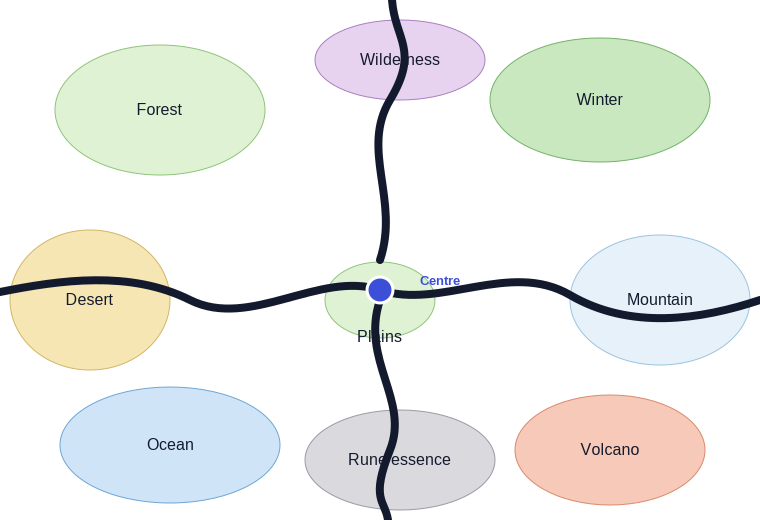
A schematic only. Biomes are placed differently from place to place, and the real roads curve in their own way.
The four roads
- One road leaves the centre to the north, one to the south, one to the east and one to the west, all the way to the sector edge.
- Each road is two tiles wide. It curves and turns, and it prefers to pass between biomes rather than through the middle of one.
- Roads never cross water or shores. They go around lakes and oceans.
- A road is a safe haven: no combat, no building and no land claims on or next to it.
The nine biomes
Biomes are roughly round or oval and between 200 and 400 tiles across. Every biome has uneven ground, with hills and bumps, so no plain is perfectly flat. Lakes and shores slope smoothly into the water.
| Biome | What you find |
|---|---|
| Plains | Regular trees, exactly three oak trees, some rocks, bushes and animals. No camels. The centre of the world sits in plains. |
| Forest | Dense trees and forest creatures such as spiders and mossy giants. |
| Desert | Cacti, palm trees, camels, small ponds, two gem rocks and two clusters each of clay, iron, tin and copper. Next to one cluster there is always one furnace and one anvil, and only one of each per desert. |
| Winter | Snow falls here. Ice trees, dead trees, wolves, ice giants and ice warriors, two mithril rocks, two coal rocks and some other rocks. |
| Ocean | The whole biome is deep water with three or four small islands. Each island has one or two maple trees and a rock, shark fishing spots on its shore and, if big enough, three ranarr plants. In about half of the oceans one island holds a water altar. This is where you sail. |
| Mountain | A range of three mountains joined together, with one walkable path up and a different path down. About ten coal, five iron, three clay, three copper, three tin and two yew trees are spread over the range. Hill giants and goats live here, and about half of the ranges have an earth altar. |
| Volcano | One huge mountain with lava at the top, using the same one way up, another way down idea. About half of volcanoes have a fire altar. Fire giants belong here, see the note below. |
| Wilderness | The most dangerous land. It holds the rarest ore and a lodestone, a slayer master and sometimes an altar. See Danger and combat and Travel and lodestones. |
| Rune essence | A strange, snowy and mystical place with two magic trees, white wolves and a rune essence mine in the middle. See Slayer and altars. |
In development. The strongest fire giants of the volcanoes are tougher than anything the beta sector can produce by distance, so they do not spawn on their own yet. Expect volcanoes to be quieter than their description suggests until the world grows.
Mountains and volcanoes: one way up
Mountains and volcanoes have steep rock you cannot walk on. There is a single walkable path from the foot to the top. A second path leads down, and it always leaves from a different side from the one you came in by. Ore and trees sit in small clearings along the paths, and altars sometimes sit on the way down.
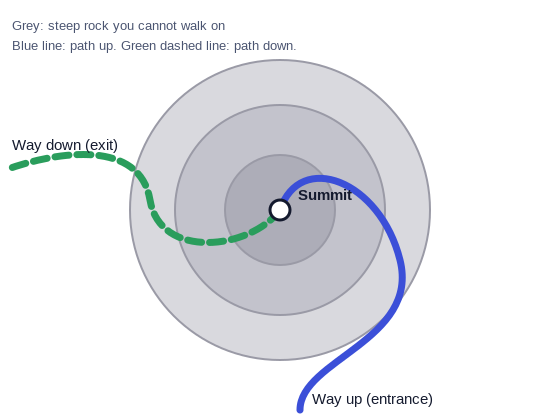
The path up and the path down use different sides of the mountain.
Tip. Look for the narrow lighter trail at the foot of a mountain. If you cannot find the way down from the summit, follow the second trail that spirals outwards instead of retracing your steps.
The world map
The world map updates as you play and uses a fog of war: the parts you have not visited stay hidden. The regions of the map are empty by design, so you only see what you have explored. Land claims near you are drawn on it as coloured rectangles. Constructed pieces are not shown.
In development. The map covers only the first part of the sector for now, and its picture is built when the world starts, so changes made while the world is running appear on the map at the next restart.
Read on: Danger and combat.