Use It or Lose It: Keeping Your Coding Skill When AI Writes the Code
An airline pilot can let the autopilot fly for most of a trip. But when it switches off in bad weather, the pilot has to fly by hand, right then. If the pilot has not flown by hand in a long time, that is a bad moment to find out.
Developers are now in a similar seat. An AI agent can write most of the code. That is useful, and this post is not against it. But if the agent writes all of your code, all of the time, a skill you spent years building starts to fade. This post explains why that happens and what to do about it.
You only need to have written some code to follow along. Every new term is explained once.
What deskilling is
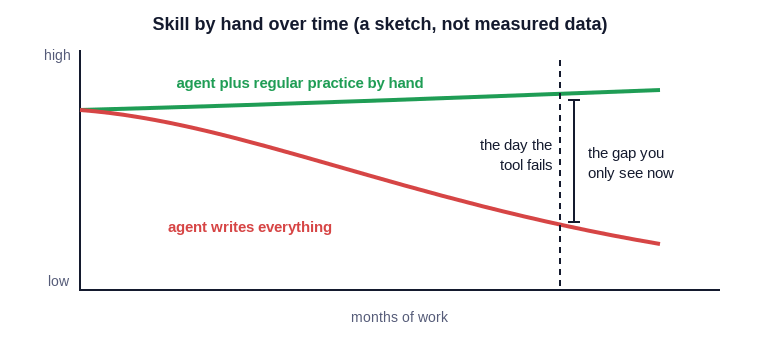
Deskilling is the loss of a skill because a tool does the task for you. It is not new. Most of us no longer know our friends' phone numbers, because the phone knows them.
In 1983 the researcher Lisanne Bainbridge described the problem in a paper called "Ironies of Automation." She studied factories and aircraft, not software. Her point was simple. When a machine takes over a task, the human's job becomes watching the machine and stepping in when it fails. But stepping in needs the very skill the human no longer practices. And the cases the machine fails on are the hard ones.
Software has the same shape. The agent handles the routine work. What is left for you is the odd bug, the unclear design choice and the review of code you did not write. Those need more skill, not less.
How using only AI causes deskilling
A skill is not a fact you store once. It is built by effort and kept by use. Pulling an answer out of your own memory makes that memory stronger than reading the answer again. This is called the testing effect. The slow ten minutes you spend stuck on a bug are often what makes the learning stay.
Now look at what an agent removes. You describe the task. The code appears. You never had to recall the syntax, pick the data structure, or find out why your first try failed. The task is done, but the step with the effort was skipped. Done once, that costs nothing. Done every day for a year, it means the skill is never used.
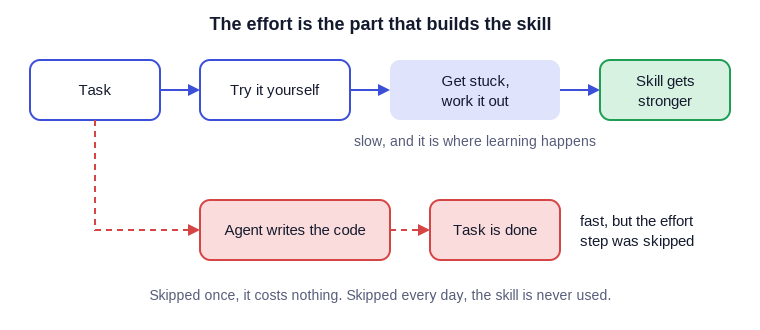
There are two versions of this. If you already had the skill, it fades from lack of use. If you never had it, it does not form at all. The second is worse for new developers, because they can not see what they are missing.
What the studies show
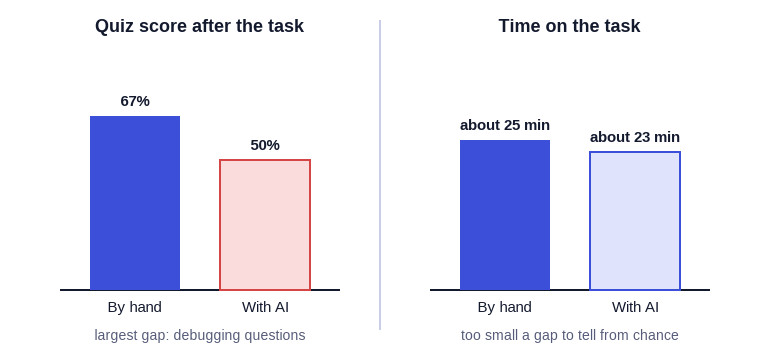
In January 2026, Anthropic published a randomized controlled trial on this question. In such a trial, people are put into groups by chance, so the groups can be compared fairly. 52 mostly junior engineers learned a new Python library called Trio. Half could use an AI assistant. Half wrote the code by hand. Then everyone took a quiz on the ideas they had just used.
The AI group scored 50 percent on average. The hand-coding group scored 67 percent. The largest gap was on debugging questions. The AI group finished about two minutes sooner, but that difference was too small to tell apart from chance. So in this study the AI users gave up a good share of the learning and did not clearly gain speed.
It is one study, with a small group and a short task. It measures learning something new, not losing something old. But other fields point the same way. A 2025 study in The Lancet Gastroenterology & Hepatology looked at doctors in four Polish centres who search for growths in the gut with a camera. After an AI helper was brought in, the doctors' detection rate on exams done without the helper fell from 28.4 percent to 22.4 percent. The study only observed 19 doctors, so it can not prove the cause. It is still an early sign from real work that a skill can weaken once AI is in the loop.
Two more results are worth knowing. In an MIT preprint of 54 people writing essays, those who used a language model had trouble quoting their own essay afterwards. A survey of 319 knowledge workers by Carnegie Mellon and Microsoft Research found that the more people trusted the AI, the less critical thinking they reported doing.
Why you will not notice it
The hard part is that deskilling is quiet. Your output does not drop. The features still ship. The loss only shows when the tool is gone, wrong or stuck.
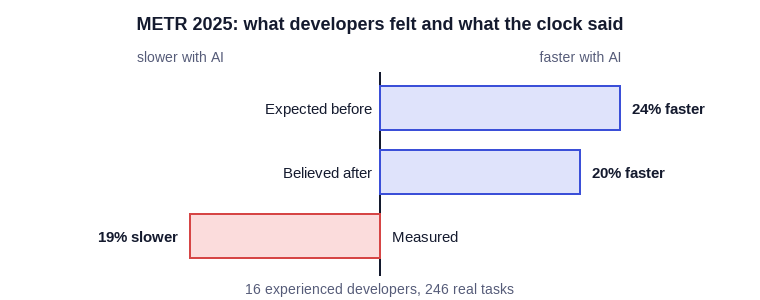
People are also poor judges of their own speed with AI. In 2025 the research group METR ran a trial with 16 experienced open-source developers on 246 real tasks in their own projects. Before the tasks, the developers expected AI to make them 24 percent faster. Afterwards they believed it had made them 20 percent faster. The clock said they took 19 percent longer. METR has since said that AI likely does help now. The lasting lesson is the gap between what people felt and what was measured.
There is also a reason tied to how the model works. As we covered in Become the Greatest Clean English Writer, a language model predicts the next token, a small piece of text, from a distribution learned from human writing. Where many people wrote the same good thing, the model is reliable. Where the topic is rare, it guesses in the same sure voice. Telling the two apart is your job. You can only do that job if you could have written the code yourself.
Coding has moved to the bottom of the V
To see where your skill is still needed, look at a picture from systems engineering called the V model. It lays out the work of building software in the shape of a V.
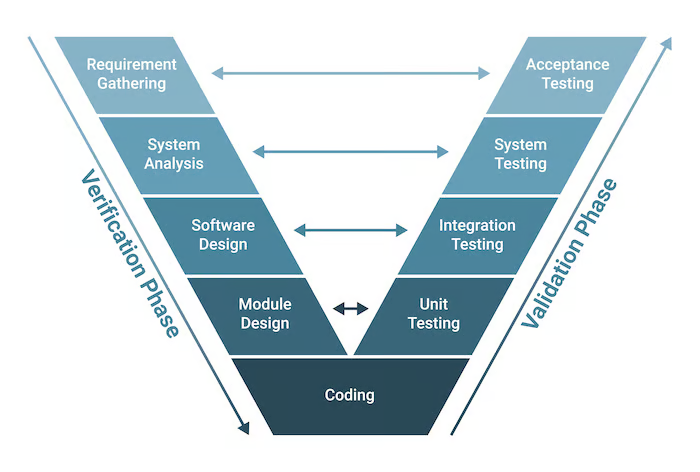
Go down the left side, which the picture calls the verification phase. First you gather requirements, which say what the users need. Then comes system analysis, which says what the whole system must do. Then software design, which splits the system into parts. Then module design, which says how each part works inside. At the bottom is coding.
Go up the right side, the validation phase. Each level tests the level across from it. Unit testing checks one module against its design. Integration testing checks that the parts work together. System testing checks the whole system against the analysis. Acceptance testing checks that the users got what they needed. The arrows show these pairs.
Now ask where the agent fits. Coding is one box out of nine, at the very bottom. That is the box agents do best. So the developer's work has moved to the other eight. You decide what to build. You design the system and its parts. You decide what "correct" means at every level, and you check it. In short, a developer should now do everything but the coding. We made the same case for writing specs in English Is the New Source Code.
Why coding practice still serves the V
This sounds like a reason to stop coding. It is the opposite. Each of the other eight boxes depends on judgment that comes from having written code.
Take the left side. A requirement is only useful if you know what is cheap and what is costly to build. A design that splits a system into parts needs a feel for where the natural seams are. Module design is close to code already. You learn all of these by building things and seeing where they hurt.
Take the right side. Writing a good unit test means knowing how code tends to break. Fixing a failed integration test means reading an error and forming a guess. Debugging was the largest gap in the Anthropic study. Review is the step that stands between the agent's code and your users, and review is reading code. Reading is trained by writing.
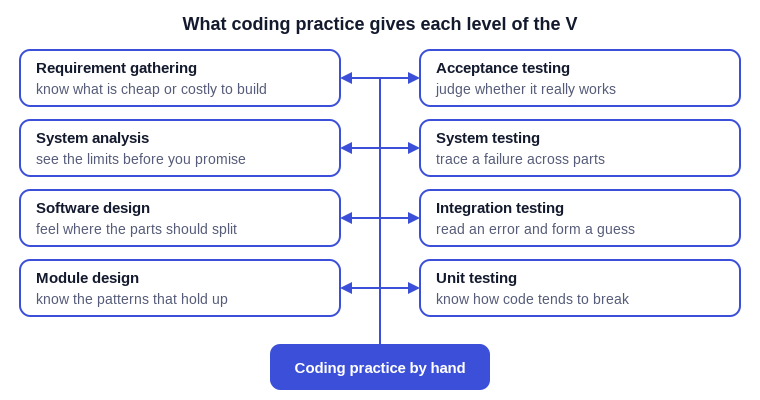
So practice at the bottom keeps the rest of the V honest. Without it you can still fill the other boxes with words. You just can not tell whether the words are right.
Two types of learning
The fix is not to give up AI. It is to keep two types of learning, and to know which one you are doing.
Learning with AI is wide. You can ask how an unknown codebase is laid out, have an idea explained three ways, or see a working example in a language you do not know. It gives you a map of a new area fast. It is weak at making the knowledge stay.
Learning without AI is deep. You close the chat, open the editor and write the code from your own head. It is slow and sometimes annoying. That effort is the point. It turns a map into a skill you can use under pressure.
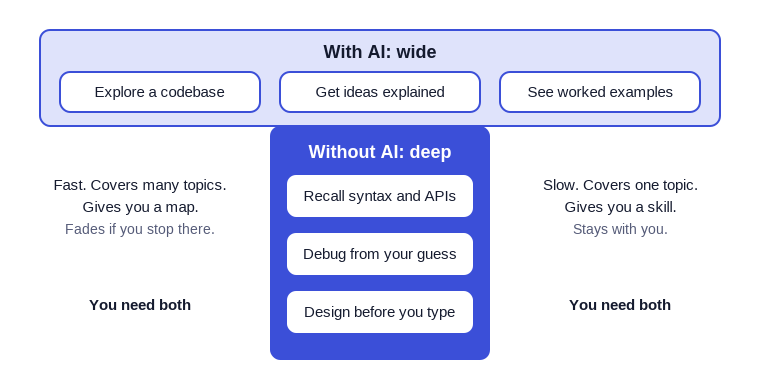
You need both. With only the first, you know about many things and can do few of them. With only the second, you miss what the tools can teach. Use AI for the map and your own hands for the practice.
The fix: write code in an IDE
The practice itself is plain. Open an IDE, which is an editor with a compiler, a debugger and a test runner built in. Turn off AI code completion for the session. Pick a small task and write it yourself.
The IDE matters because it gives feedback without giving answers. The compiler tells you a type is wrong, but you fix it. The debugger lets you stop on a line and look at the values, but you form the guess. The test runner says pass or fail. The agent normally runs that loop of try, fail, read and fix. Here you run it.
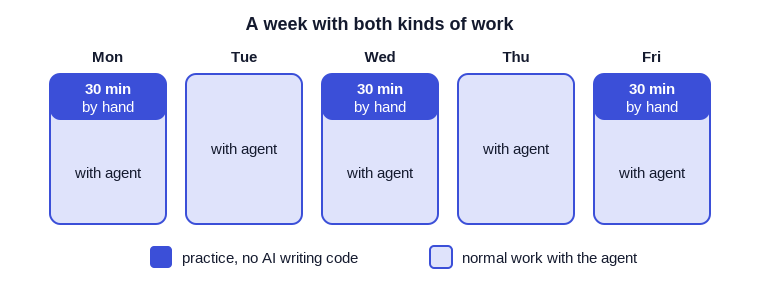
Keep sessions short and regular. Thirty minutes a few times a week beats one long day a month. Typing by hand also puts load on your hands and arms, so pace it. Our post How to Code Forever covers how to keep coding without pain.
Use AI as an assistant, not the author
Practice does not have to mean no AI at all. It means the AI does not write the code. The Anthropic study found that how people used the assistant mattered a lot. Those who handed over the whole task, leaned on it more and more, or had it fix each error scored under 40 percent. Those who asked it about ideas, or asked for an explanation along with any code, scored 65 percent or more.
So during practice, treat the AI like a senior colleague at the next desk. Ask what an error message means. Ask why one approach is better than another. Ask it to review code you have finished and point out what you missed. Do not ask it for the solution. If you are stuck, ask for a hint, and take the smallest one that gets you moving.
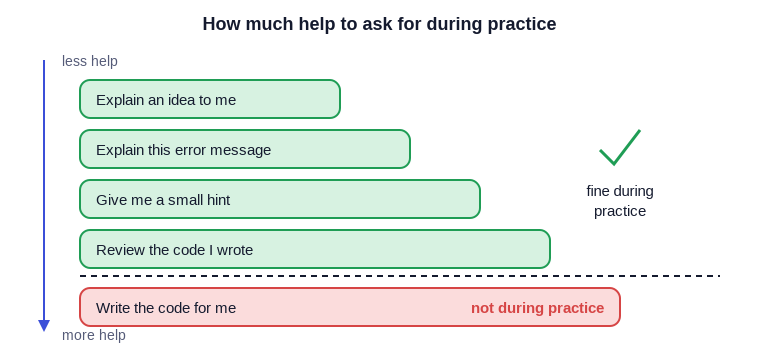
One rule covers it. Every line in the file should be a line you typed and can explain.
Recreate real issues and pull requests
Toy exercises get dull fast. A better source of practice is public: the history of open-source projects. An issue is a written report of a bug or a wanted feature. A pull request is the proposed code change that settles it. Every merged pull request is a real task with a known good answer.
Here is the method. Pick a project in a language you use. Find a closed issue that links to a merged pull request, and read only the issue. Check out the commit just before the fix. Recreate the bug, so you can see it fail. Then write the fix and a test yourself, in your IDE.
When you are done, open the real pull request and compare. Did the maintainers handle a case you missed? Was their change simpler? Now bring in the AI and ask it to explain the differences between your change and theirs. This is the learning with AI, placed after the effort without it, where it helps most.
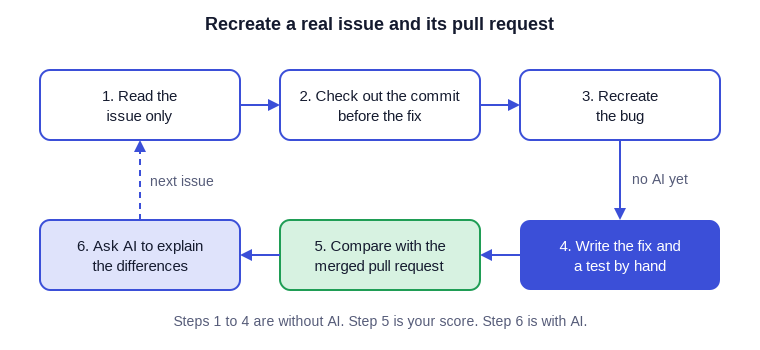
This works for the same reason the matching trick in The Locked Box Is Open works. You have a known answer to compare against, so you get an honest score and not a feeling. In the words of our post on reinforcement learning, the merged pull request is your ground truth. It also trains the upper parts of the V, because you read a requirement and find your way through a real system.
Why a systems approach is better for designing a product
One more skill sits at the top of the V. It is thinking in systems.
A system is a set of parts plus the connections between them. The behavior you care about often lives in the connections. A login page, a database and a payment service can each work alone and still fail together, because one sends a date in a form the other does not expect.
The other way to build is one part at a time. You ask the agent for a feature, then another, then another. Each one looks fine. But nobody decided how the parts should fit, so each new piece makes its own guess. Agents make this easy to fall into, because parts now cost almost nothing to make. An agent also works from its context window, the limited text it can see at once. It can only follow a design that someone wrote down and put there.
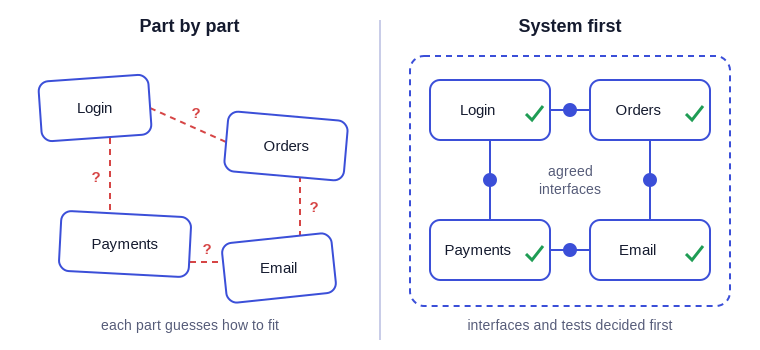
A systems approach starts from the top of the V. Write down what the user needs. Decide what the whole product must do. Split it into parts and define the interfaces, the agreed ways the parts talk to each other. Decide how each level will be tested. Only then fill in the parts, and here the agent is a great help.
This is better for three reasons. First, mistakes in requirements and design are caught on paper, where they are cheap to change. Second, clear interfaces let you hand small, bounded tasks to an agent and check each one alone. We saw a version of this in Why AI Agents Love Binaries, where a tool with a clear command and exit code is easy for an agent to use. Third, every part has a matching test, so you know when it is done.
Fred Brooks wrote in 1986 that the hardest single part of building software is deciding what to build. Agents have made the typing cheap. The deciding is still yours.
Summary
Using only AI causes deskilling because skill is built by effort and kept by use, and the agent removes both. The loss is quiet, and people tend to misjudge it. The studies so far are early and small, but they point the same way.
The answer is two types of learning. Use AI to explore and explain. Then practice without it writing the code: in an IDE, on real issues and pull requests, with the AI as an assistant that explains and reviews. Use what that practice gives you on the rest of the V model, and design products as systems from the top down. Let the agent write the code. Keep the ability to write it yourself.
Sources
- Judy Hanwen Shen and Alex Tamkin, "How AI assistance impacts the formation of coding skills," Anthropic, 2026: https://www.anthropic.com/research/AI-assistance-coding-skills and https://arxiv.org/abs/2601.20245
- Lisanne Bainbridge, "Ironies of Automation," Automatica, 1983: https://doi.org/10.1016/0005-1098(83)90046-8
- Henry Roediger and Jeffrey Karpicke, "Test-Enhanced Learning: Taking Memory Tests Improves Long-Term Retention," Psychological Science, 2006: https://doi.org/10.1111/j.1467-9280.2006.01693.x
- Budzyń et al., "Endoscopist deskilling risk after exposure to artificial intelligence in colonoscopy: a multicentre, observational study," The Lancet Gastroenterology & Hepatology, 2025: https://doi.org/10.1016/S2468-1253(25)00133-5
- Kosmyna et al., "Your Brain on ChatGPT: Accumulation of Cognitive Debt when Using an AI Assistant for Essay Writing Task": https://arxiv.org/abs/2506.08872
- Lee et al., "The Impact of Generative AI on Critical Thinking," CHI 2025: https://doi.org/10.1145/3706598.3713778
- METR, "Measuring the Impact of Early-2025 AI on Experienced Open-Source Developer Productivity": https://metr.org/blog/2025-07-10-early-2025-ai-experienced-os-dev-study/
- METR, "We are Changing our Developer Productivity Experiment Design," 2026: https://metr.org/blog/2026-02-24-uplift-update/
- "V-model (software development)," Wikipedia: https://en.wikipedia.org/wiki/V-model_(software_development)
- NASA Systems Engineering Handbook: https://www.nasa.gov/reference/systems-engineering-handbook/
- Frederick Brooks, "No Silver Bullet: Essence and Accident in Software Engineering," 1986: https://www.cs.unc.edu/techreports/86-020.pdf
- Our earlier posts: 1.md, 2.md, 3.md, 4.md, 5.md and 6.md